

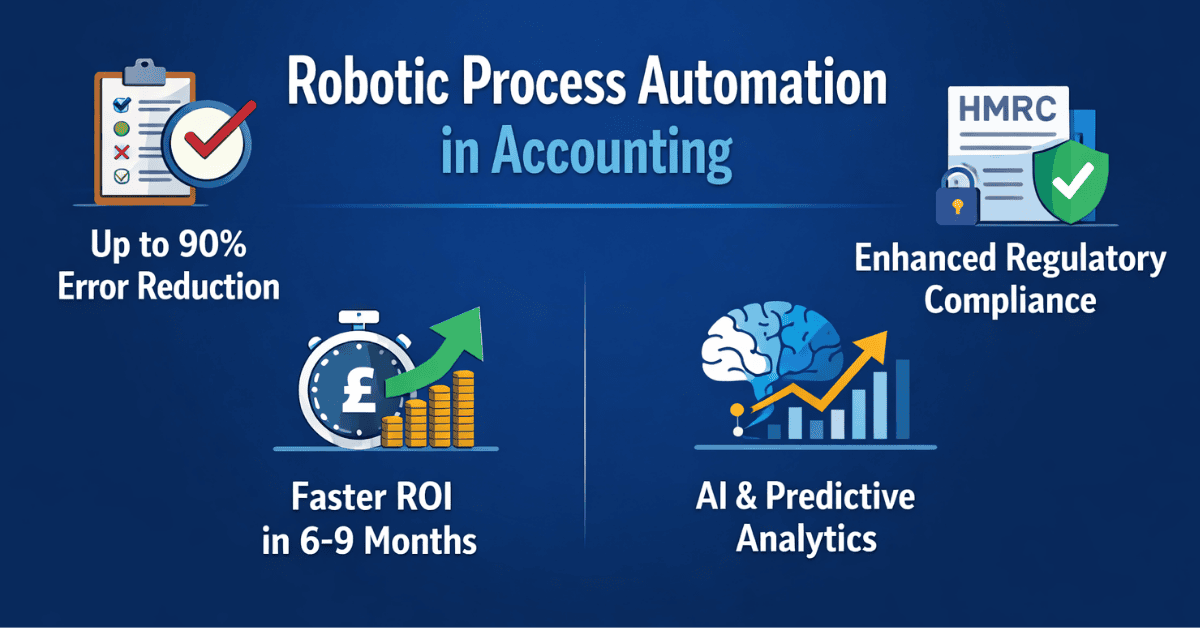
The accounting landscape is undergoing a profound transformation. As digital innovation boots, Robotic Process Automation (RPA) in accounting has evolved from a competitive advantage into a fundamental operational requirement for the best process automation in Accounting
For businesses operating in London’s dynamic financial environment, adopting automation is no longer optional—it is essential for maintaining compliance, reducing operational costs, and scaling efficiently without increasing workforce size.
Table of Contents
- What is Robotic Process Automation (RPA) in Accounting?
- How Does RPA Benefit London Businesses?
- Comparison: RPA vs. Traditional Accounting
- 4. What are the Primary Use Cases for RPA in Modern Finance?
- How is AI Transforming RPA in 2026?
- Is RPA Essential for HMRC Making Tax Digital (MTD) Compliance?
- Why Partner with Synergy Tax Accountants?
- 8.Frequently Asked Questions (FAQs)
- About Author
1. What is Robotic Process Automation (RPA) in Accounting?
Robotic Process Automation (RPA) refers to advanced software solutions—commonly known as “bots”—designed to execute high-volume, rule-based financial processes. Unlike traditional systems, these bots replicate human interactions with digital platforms, such as logging into portals, extracting data from invoices, and updating accounting records. However, they perform these tasks with unmatched accuracy, speed, and 24/7 availability.
In 2026, RPA has progressed beyond simple task automation. It now serves as a critical foundation for Agentic AI, enabling systems not only to execute processes but also to detect anomalies, manage exceptions, and deliver real-time financial insights that support strategic decision-making.
2. How Does RPA Benefit London Businesses?
London’s financial sector operates under intense pressure, including rising operational expenses and stringent regulatory frameworks such as HMRC’s Making Tax Digital (MTD). RPA imparts a powerful solution to these challenges:
- Up to 90% Error Reduction: Automation eradicates manual data entry errors, ensuring consistently accurate and “audit-ready” financial records.
- Rapid Return on Investment: Many London-based firms achieve full ROI within 6 to 9 months due to significant productivity gains.
- Improved Regulatory Compliance: RPA establishes a permanent digital audit trail, supporting real-time reporting requirements under HMRC regulations.
- Scalable Operations for SMEs: Small and medium-sized enterprises can efficiently manage large transaction volumes without expanding their workforce.
3. Comparison: RPA vs. Traditional Accounting
For firms still relying on manual entry or basic spreadsheets, the gap in efficiency is widening.
| Features | Traditional Accounting | RPA-Enabled Accounting |
| Data Entry | Manual, prone to human error | Automated, 100% accuracy |
| Availability | 40 hours per week (standard) | 168 hours per week (24/7) |
| MTD Compliance | High risk of digital link breaks | Seamless, native digital links |
| Cost Scale | Costs increase with transaction volume | Costs remain flat as volume grows |
| Audit Trails | Often fragmented or manual | Automatic, real-time, and digital |
4. What are the Primary Use Cases for RPA in Modern Finance?
RPA is transforming core accounting functions across organizations:
- Accounts Payable & Receivable
Automation streamlines invoice processing, validates transactions against purchase orders, and schedules payments seamlessly. - Bank Reconciliation
Bots efficiently match thousands of transactions across bank feeds and internal ledgers, significantly reducing processing time. - Payroll Management
Complex tax calculations, PAYE submissions, and employee payments are handled with precision and compliance. - Financial Reporting
Real-time generation of profit and loss statements, balance sheets, and cash flow forecasts using integrated cloud data sources.
5. How is AI Transforming RPA in 2026?
The convergence of Artificial Intelligence (AI) and RPA has led to the rise of hyper automation. While RPA focuses on execution, AI introduces intelligence and adaptability.
In 2026, AI-powered automation enables businesses to:
- Process Unstructured Data: Interpret handwritten documents, emails, and non-standard invoices with high accuracy.
- Leverage Predictive Analytics: Anticipate cash flow issues and financial trends before they impact operations.
- Enhance Fraud Detection: Identify suspicious transactions in real time using machine learning models.
6. Is RPA Essential for HMRC Making Tax Digital (MTD) Compliance?
Yes—RPA plays a crucial role in achieving compliance with HMRC’s Making Tax Digital (MTD) requirements.
From April 2026, businesses with income exceeding £50,000 must maintain digital records and submit quarterly updates. RPA ensures the creation of compliant digital links, eliminating manual data transfers such as copy-pasting, which are strictly prohibited by HMRC.
By implementing RPA, businesses can confidently meet evolving UK tax regulations while minimising compliance risks.
7. Why Partner with Synergy Tax Accountants?
At Synergy Tax Accountants London , we specialise in integrating advanced automation with modern accounting practices. Located in Mayfair, London, our firm is ideally positioned to support businesses transitioning to intelligent financial systems.
Our approach goes beyond implementation—we offer a strategic partnership led by Chartered Certified Accountants with deep expertise in both regulatory compliance and emerging technologies
Whether you are introducing RPA for the first time or enhancing an existing automation framework, we ensure your financial operations are:
- Efficient
- Accurate
- Fully compliant
- Future-ready
8. Frequently Asked Questions (FAQs)
Q: Is RPA expensive for small businesses?
A: While initial setup costs exist, most businesses achieve full 100%ROI within the first year through reduced labour costs and improved accuracy.
Q: Can RPA integrate with software like Xero or QuickBooks?
A: Of course. RPA seamlessly integrates with leading accounting platforms, creating efficient digital connections between systems.
Q: Will RPA replace accountants?
A: No. RPA eliminates repetitive tasks, enabling accountants to focus on high-impact services such as tax planning, advisory, and business growth strategies.
9. About Author
This article was incorporated by the Synergy Tax Accountants Team, a group of experienced financial professionals with over 20 years of expertise in accounting and technology. We are dedicated to assist London businesses achieve operational excellence through innovation, automation, and strategic financial management.